LEO Earth Observation
X-band bulk downlink with burst scheduling support. High-inclination orbital coverage, multi-aperture handoffs for extended contact windows, and priority queue access for time-sensitive imagery products.
Learn moreGround Station Network · El Segundo CA
Orbitvein connects LEO and MEO operators to a managed network of S-, X-, and Ka-band ground stations. No infrastructure. No long-term contracts. First contact scheduled in under 48 hours.
Submit your NORAD catalog ID or TLE set via the API or contact form. Our propagation engine computes pass predictions for the next 7 days across all available stations, accounting for minimum elevation masks and frequency band availability.
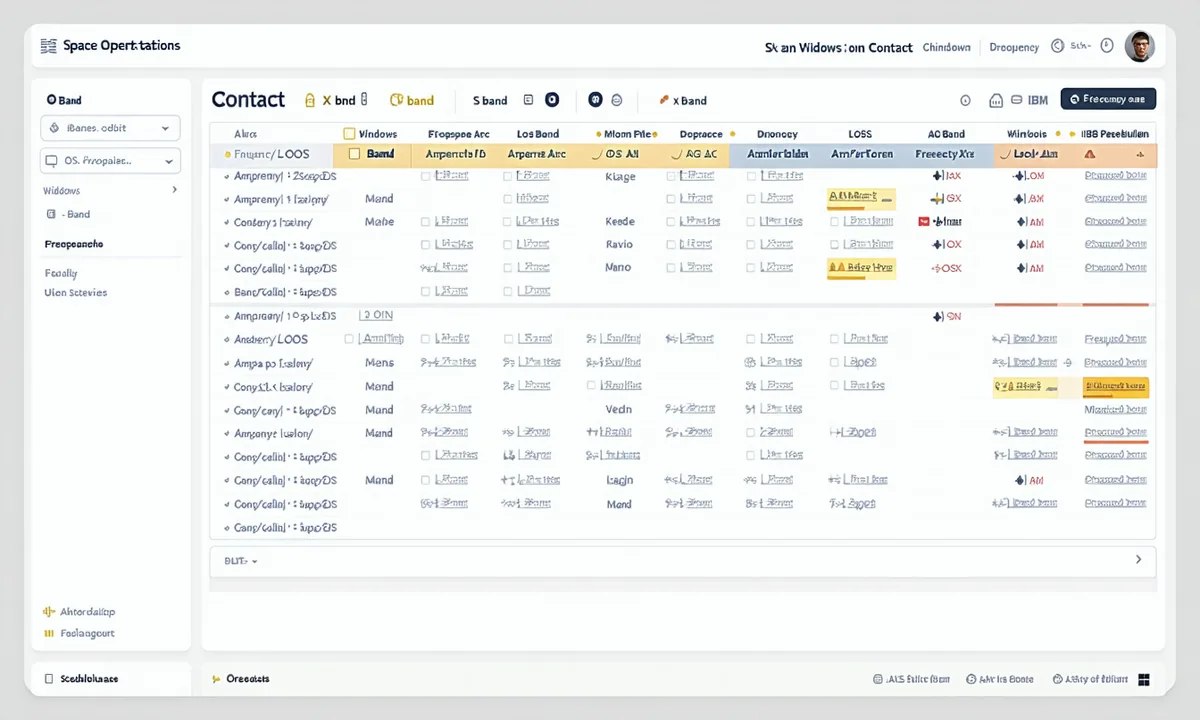
Select an AOS/LOS time slot, preferred aperture size, and frequency band. The scheduler performs real-time conflict checking across all active reservations and confirms your contact window — typically within minutes.
CCSDS-framed packet capture is delivered to your designated cloud endpoint immediately post-contact. Telemetry logs, Doppler tracking data, and contact reports are available via the API within minutes of LOS.
| Aperture | G/T (dB/K) | EIRP (dBW) | Bands | Tracking |
|---|---|---|---|---|
| 3.7 m | 18.5 | 52 | S, X | 0.08 mdeg |
| 5.4 m | 22.1 | 58 | S, X | 0.06 mdeg |
| 7.3 m | 26.4 | 64 | X, Ka | 0.05 mdeg |
| 9.0 m | 29.8 | 68 | X, Ka | 0.04 mdeg |
Four operational stations span the Pacific Rim, North Atlantic, Mid-continent, and Southern hemisphere access zones. Station positioning is optimized for high-inclination LEO pass geometry, providing overlapping coverage windows for polar, sun-synchronous, and near-polar operators.
Each station operates 24/7 with scheduled maintenance windows disclosed at least 72 hours in advance. Contact redundancy routing is available for Constellation tier and above — if your primary station has a scheduling conflict, the system automatically offers an alternate window at the nearest compatible site.
All stations support CCSDS TC and TM framing, virtual channel multiplexing (up to 8 VCIDs per physical link), and full Doppler pre-compensation from AOS to LOS. We are not a satellite broadband provider — this infrastructure is built specifically for spacecraft operators who need reliable, schedulable antenna access.
X-band bulk downlink with burst scheduling support. High-inclination orbital coverage, multi-aperture handoffs for extended contact windows, and priority queue access for time-sensitive imagery products.
Learn moreS-band bi-directional TT&C at scale. API-driven uplink command sequencing for multi-spacecraft planes, low-latency confirmation, and scheduling optimized for high plane-count operations.
Learn morePer-pass pricing with no minimum commitment. NORAD ID onboarding within 24 hours. Flexible contact windows for university programs, early-mission validation, and experimental payloads.
Learn moreNo hidden fees. No lock-in. Pay for the contacts you use.
Up to 5 contacts/month · S or X band · 3.7m aperture · 10-min max
10 contacts/month bundle ($1,980/mo) · X and Ka band · Up to 7.3m
10+ spacecraft · Custom SLAs · Dedicated windows · Full API integration
Send us your NORAD ID and preferred frequency band. We handle the rest.