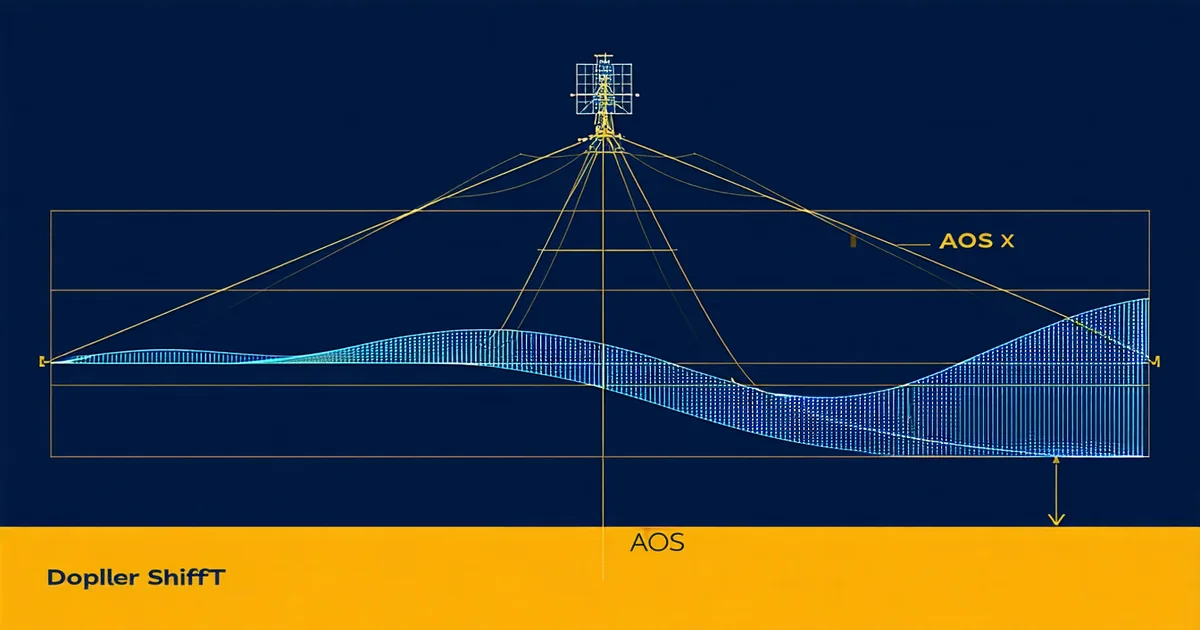
A LEO spacecraft at 400 km altitude moves at approximately 7.7 km/s relative to an inertial frame. From the perspective of a ground station, that velocity produces a radial component that varies from near-zero at AOS and LOS (when the spacecraft is moving nearly tangentially to the ground station line-of-sight) to a maximum somewhere mid-pass. At S-band (2.2 GHz), that motion produces Doppler shifts of ±40–50 kHz. At X-band (8.1 GHz), the same velocity profile generates ±145–180 kHz of Doppler. At Ka-band (26 GHz), the shift reaches ±460–580 kHz.
Two distinct subsystems deal with this motion: the antenna tracking system, which must keep the beam pointed at the spacecraft despite rapid azimuth and elevation changes, and the signal processing chain, which must compensate for the Doppler-shifted carrier frequency in real time. Both have performance characteristics that operators should understand when evaluating a ground station.
The Kinematics of a LEO Pass
At AOS (elevation ≈ 5–10°), a spacecraft at 400 km altitude is approximately 2,000–2,300 km slant range from the station. Elevation angle rate is relatively slow — perhaps 0.2–0.5 deg/s. As the spacecraft approaches maximum elevation, elevation rate accelerates sharply; for a high-elevation pass (max elevation 80–85°), the elevation rate at maximum can reach 5–8 deg/s, and azimuth rate can briefly exceed 20–30 deg/s near the zenith as the spacecraft passes nearly overhead.
This is the kinematic challenge that separates LEO tracking from GEO tracking. A geostationary satellite barely moves relative to the ground; you can point at it once and leave the antenna there for hours. A LEO spacecraft at 500 km altitude demands continuous, high-rate, high-accuracy pointing for the entire 7–12 minute contact window, with the fastest rates concentrated in the highest-value middle portion of the pass where elevation angle — and therefore G/T — is at its peak.
Mechanical Autotrack: How Monopulse and Conical Scan Work
Most precision ground station antennas use one of two closed-loop tracking methods: monopulse or conical scan. Understanding the distinction matters because their tracking accuracy, latency, and sensitivity to signal-to-noise ratio differ in ways that affect link performance.
Monopulse Tracking
Monopulse tracking uses a multi-horn feed assembly that simultaneously produces a sum channel (Σ) and two difference channels (ΔAz and ΔEl). The ratio of difference channel amplitude to sum channel amplitude produces an error signal proportional to the angular offset between the beam boresight and the target. This error signal drives the mount control system to null the offset in real time.
The key property of monopulse is that the error signal is derived from a single pulse (hence the name) — or in continuous-wave terms, from a single snapshot of the signal. There is no dwell time required to generate tracking error; the correction is computed instantaneously from the received signal geometry. This gives monopulse inherently low tracking latency and high tracking bandwidth, capable of following the most aggressive LEO pass geometries without lag-induced pointing error.
The sensitivity limitation: monopulse requires the signal-to-noise ratio in the sum channel to be sufficient to compute a reliable difference ratio. At low signal levels near AOS or at high noise temperature, the difference channel becomes noisy and tracking accuracy degrades. Well-designed monopulse systems maintain sub-millidegree accuracy at received C/N₀ values above approximately 10–15 dB·Hz; below that threshold, the system typically falls back to program track (open-loop pointing from TLE prediction) until signal strengthens.
Conical Scan Tracking
Conical scan generates tracking error by rotating (scanning) the squint angle of the antenna beam in a small cone around the boresight axis at a fixed scan frequency, typically 20–100 Hz. When the target is exactly on boresight, the received amplitude is constant across the scan cycle. When the target is offset, the amplitude modulation at the scan frequency contains the error information.
Conical scan is mechanically simpler and cheaper to implement than monopulse but has two operational disadvantages: it is sensitive to amplitude modulation from the spacecraft at or near the scan frequency (a spacecraft attitude-dependent antenna pattern change that happens to modulate at 50 Hz will corrupt the tracking error signal) and it averages signal over multiple scan cycles, introducing a tracking lag that grows with scan period. For high-rate LEO passes with rapidly changing azimuth, this lag can produce a few millidegrees of pointing bias near pass maximum. For most commercial missions, this is an acceptable performance level; for high-gain Ka-band links where the 3 dB beamwidth of a 5.4 m dish is only 0.08°, even a 2–3 mdeg pointing bias at the 1σ level represents about 1.5–2.0 dB of pointing loss.
Tracking Accuracy in Millidegrees: Link Margin Translation
Pointing loss (Lpt) for a Gaussian beam is approximately:
Lpt ≈ 12 (σpt / θ3dB)² dB
where σpt is the 1σ tracking error in degrees and θ3dB is the antenna 3 dB beamwidth. For a 5.4 m dish at X-band (8.1 GHz), θ3dB ≈ 0.26°. With a tracking accuracy of 5 mdeg (0.005°) RMS, Lpt ≈ 12 × (0.005/0.26)² ≈ 0.044 dB — negligible. With arc-minute-class tracking (0.1°) on the same dish, Lpt ≈ 12 × (0.1/0.26)² ≈ 1.8 dB — a material link margin penalty that cannot be recovered without reducing data rate.
At Ka-band with a 5.4 m dish, θ3dB ≈ 0.085°. Now arc-minute tracking gives Lpt ≈ 12 × (0.1/0.085)² ≈ 16.6 dB — catastrophic, effectively de-pointing the antenna from the spacecraft. Ka-band operationally requires monopulse autotrack with <10 mdeg RMS accuracy on any reasonably sized aperture.
Doppler Compensation: Pre-Correction vs. Closed-Loop
The signal processing chain must track the Doppler-shifted carrier. Two approaches are used in practice: open-loop pre-correction and closed-loop carrier tracking.
Open-loop pre-correction uses the pass prediction ephemeris (from the TLE and SGP4 propagation) to compute the predicted Doppler profile — a frequency-vs-time table — and programs the ground receiver's local oscillator to track the expected Doppler trajectory. This approach works well when the TLE is fresh and the satellite is not maneuvering. The residual Doppler error from TLE uncertainty is typically 10–50 Hz at S-band and 40–180 Hz at X-band for a 24-hour-old TLE at 500 km altitude — within the acquisition bandwidth of most modern demodulators.
Closed-loop carrier tracking uses a phase-locked loop (PLL) or frequency-locked loop (FLL) in the demodulator to follow the actual received carrier, regardless of the predicted Doppler. This is more forgiving of TLE errors and spacecraft transponder frequency drift but requires adequate signal strength for the loop to maintain lock through the high-Doppler-rate portions of the pass near maximum elevation. Loop bandwidth must be set to accommodate the maximum Doppler rate (frequency change per second) — at S-band this can reach 10–15 Hz/s near pass maximum for a 400 km orbit, requiring a loop bandwidth of at least 30–50 Hz for robust tracking.
Electronic Beam Steering: Current Limitations for Commercial LEO Ops
Flat-panel phased array antennas capable of electronic beam steering without mechanical motion are an active area of development in the commercial ground segment market. The appeal is obvious: no moving parts, near-instantaneous beam repositioning, and the potential to serve multiple spacecraft from a single aperture using multiple simultaneous beams. Several vendors have demonstrated commercial-band phased arrays for LEO ground segment applications.
The practical limitation at present is G/T. A phased array aperture that fits in a practical form factor (say, 1 m × 1 m) achieves G/T roughly equivalent to a 1.2–1.5 m mechanical dish — adequate for high-EIRP spacecraft or lower data rate TT&C, but significantly below the 5–9 m aperture systems needed for bulk X-band data downlink at 100+ Mbps from typical smallsat transmitter power levels. The efficiency penalty of current commercial phased array designs (beam-pointing induced gain reduction, mutual coupling losses at wide scan angles) further degrades effective G/T at the edges of the field of view. For Ka-band specifically, phased array element pitch must be very small (sub-centimeter), pushing element count and cost high.
This is not an argument against phased array systems — for IoT constellation TT&C or lower-rate monitoring applications they are a well-suited match. We are not saying mechanical tracking systems will dominate indefinitely; the technology gap is closing. But for operators planning bulk X-band or Ka-band data downlink today, a well-maintained mechanical autotrack mount with a 5–9 m aperture and sub-10-mdeg tracking accuracy remains the practical choice.