The decision to build your own ground station or use a managed network has a clear right answer for most early-stage commercial LEO operators — and that answer is not "build your own." But the analysis that gets you to that conclusion takes more specificity than the usual hand-wave about capex versus opex. This piece runs the numbers for a concrete scenario and calls out the assumptions that change the answer.
The Scenario: 3-Spacecraft LEO Earth Observation Constellation
Three spacecraft, 500 km sun-synchronous orbit, X-band downlink at 150 Mbps, moderate imaging payload with roughly 200 GB of data per spacecraft per day to downlink. Mission lifetime: 5 years. The team is eight engineers, the company is in its second year of operations, bootstrapped or lightly funded. The question: build a dedicated 5.4 m X-band station at their primary location, or use a managed GSaaS network?
The Build Side: Capex and Hidden Costs
A 5.4 m X-band antenna system with autotrack mount, LNA at 50–60 K system noise temperature, and a basic CCSDS demodulator/bit synchronizer will run $600K–$1.2M in total installed cost, depending on the mount supplier and whether the feed system supports dual linear or circular polarization. That range is industry-realistic: a complete antenna plus RF front end plus az/el mount plus foundation and cabling, not including any on-site infrastructure (power, shelter, data connectivity).
Add the site: if you are co-locating at your office campus, costs include structural engineering for the foundation, local building permits (typically 4–8 months in the US, sometimes longer depending on zoning), and a rooftop or pad evaluation for RF interference from neighboring emitters. If you are locating at a remote site for better sky coverage, add land access agreements, power provisioning (often $50K–$200K for utility connection or diesel infrastructure at rural sites), and secure data connectivity (a fiber pull or microwave backhaul link).
Then there is the regulatory layer. An X-band downlink receiving station in the US requires FCC or NTIA coordination depending on whether you are a commercial or federal entity. FCC licensing under Parts 25 or 5 applies to most commercial satellite earth stations; the process typically takes 3–6 months for a straightforward application and involves frequency coordination with neighboring licensees. If your site is near an airport or military installation, additional coordination with the FAA or NTIA is triggered. Budget $20K–$60K in legal/consulting fees for the licensing process, plus time.
Year 1 Capital Summary (Build Scenario)
| Cost Item | Low Estimate | High Estimate |
|---|---|---|
| Antenna + RF system + mount | $600,000 | $1,200,000 |
| Site infrastructure (foundation, power, connectivity) | $80,000 | $350,000 |
| FCC/NTIA licensing + legal | $20,000 | $60,000 |
| Ground software (TLE ingestion, scheduler, demod config) | $30,000 | $120,000 |
| Total Year 1 Capex | $730,000 | $1,730,000 |
The Build Side: Ongoing Opex
A 24/7 ground station requires staffing. A realistic minimum for continuous operations of one station serving a 3-spacecraft constellation is 1.5–2.0 FTE of ground systems engineering and operations coverage. At a market rate of $110K–$150K fully loaded cost per engineer in a commercial space hub, that is $165K–$300K per year in direct personnel cost — not counting the lost engineering capacity from diverting someone from payload analysis or mission operations to ground station babysitting.
Maintenance contracts for the antenna mount and RF system: typically 5–10% of hardware cost per year after warranty expiration. On a $900K system, that is $45K–$90K annually. Add software license renewals, connectivity costs (data backhaul), and annual regulatory fee payments, and total steady-state opex for a single dedicated station in the build scenario runs $250K–$450K per year.
The GSaaS Side: Constellation Tier Economics
For a 3-spacecraft constellation generating 200 GB/spacecraft/day with a typical 6–8 contact windows per spacecraft per day at a managed network, contact volume runs roughly 18–24 contacts per day total. At Orbitvein's Constellation tier pricing of $198/contact effective rate (10-contact bundle at $1,980/month), the monthly spend for 3 spacecraft with 20 contacts/day would be approximately $3,960–$5,940 per spacecraft per month, or $11,880–$17,820/month for the full constellation. Annually: $142,560–$213,840.
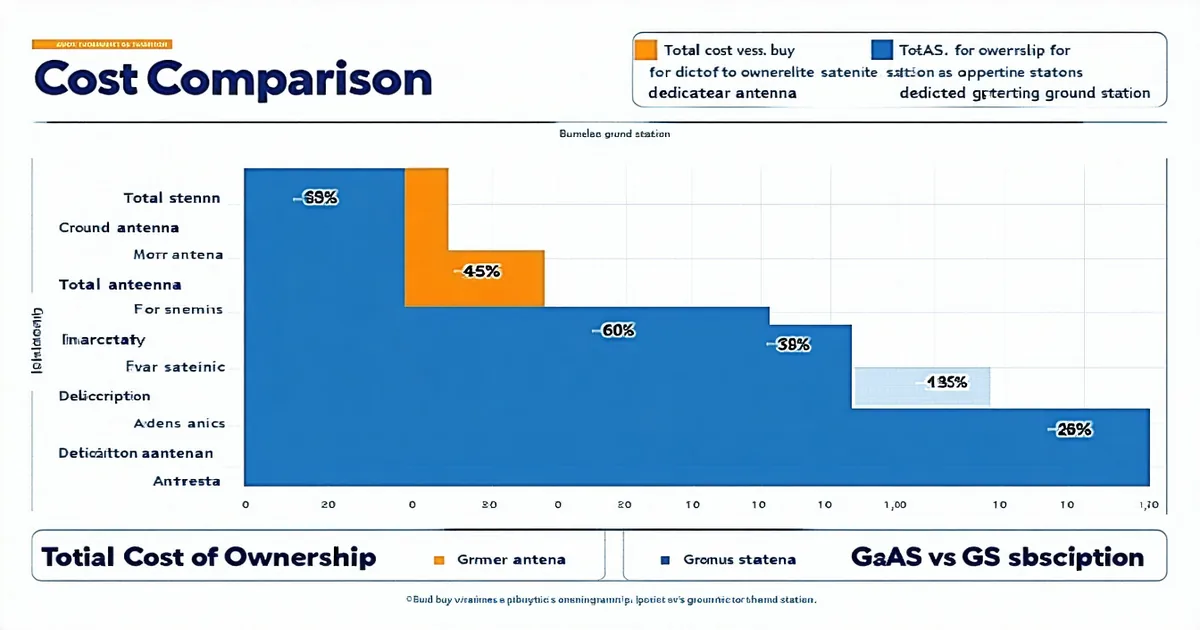
For a 5-year horizon, total GSaaS spend: $712K–$1.07M. Compare to the dedicated station 5-year TCO: $730K–$1.73M capex plus $250K–$450K/year opex = $2.0M–$4.0M total. The GSaaS scenario is 2–4x cheaper over five years for this contact volume profile, with zero capex, no licensing burden, and no operations staffing requirement.
When the Build Scenario Actually Makes Sense
We are not saying building a dedicated ground station is always the wrong call. The economics shift when contact volume is high enough that per-contact GSaaS pricing exceeds the amortized cost of owned infrastructure. A constellation of 20+ spacecraft with 5–10 contacts per spacecraft per day — 100–200 contacts per day total — starts to approach the crossover point where dedicated infrastructure at a strategic latitude (e.g., a southern hemisphere site for high-inclination SSO coverage) becomes cost-competitive on a per-contact basis after year 3 or 4, once the capex is amortized and the operations team is already sized for mission control anyway.
The other case for dedicated infrastructure: mission-specific RF requirements that commercial GSaaS networks don't carry. If your spacecraft requires a 9 m or larger aperture for a particularly weak transmitter, or needs a highly specialized feed (e.g., a non-standard polarization or a frequency outside S/X/Ka), you may have no alternative. But for the vast majority of commercial LEO operators in 2024–2025, a 3.7–7.3 m X-band capable shared network covers the mission requirements with margin to spare.
The Redundancy Argument
One argument that consistently comes up in build-vs-buy discussions: "If I own the station, I have guaranteed availability." This deserves scrutiny. A single dedicated station is a single point of failure. Hardware outages, scheduled maintenance, and local weather events (lightning, ice loading) all affect availability. A managed network with 4–5 geographically distributed stations, each capable of serving your orbit, provides significantly higher overall contact availability than a single owned station — even accounting for shared-use scheduling conflicts. The redundancy argument, examined carefully, typically points toward GSaaS rather than away from it for operators at this scale.
What Changes at Scale: The Latent Crossover
There is a nuance in the crossover calculation that the simple cost-per-contact comparison misses. As your constellation grows from 3 to 10 to 20 spacecraft, two things happen simultaneously: your total contact volume increases linearly with spacecraft count, and your operational sophistication deepens. The operations team you hire to run 20 spacecraft needs command scheduling capability, TLE management, anomaly response, and contact execution monitoring regardless of whether the ground station is owned or rented.
At the 20-spacecraft scale, the marginal cost of adding owned ground station operations to an already-staffed mission ops team is lower than it was at the 3-spacecraft stage, where the team was doing everything. An operator at 20+ spacecraft who is paying $30K–$50K per month in GSaaS fees has a strong economic incentive to model whether 1–2 strategically placed owned stations could absorb their primary contact load and reduce the variable cost exposure. That analysis is genuinely mission-specific and depends on orbital geometry, contact frequency, and how much of the team's capacity is already dedicated to ground operations.
The point is not that GSaaS is always cheaper at scale — it is that the decision should be made with actual numbers, not instinct. Most operators who have run both analyses find that the owned-infrastructure crossover point is further out than their initial estimate suggested, because the full opex cost of station ownership — staffing, maintenance, RF licensing renewals, hardware refresh cycles — consistently exceeds the rough numbers used in early build-vs-buy conversations.