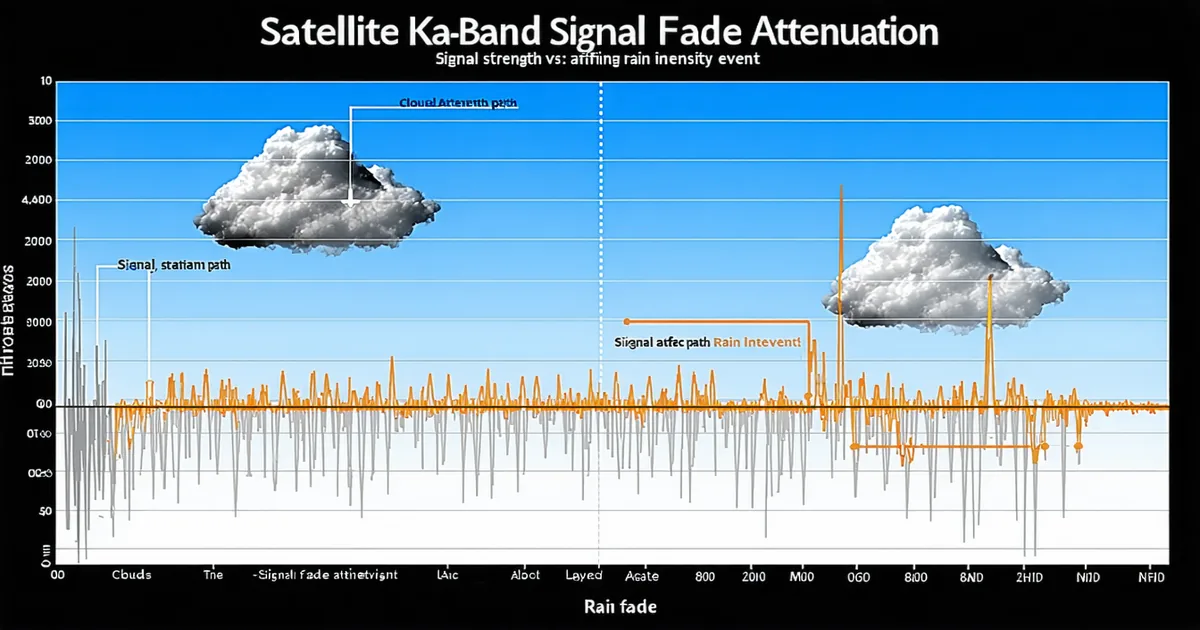
Ka-band downlinks between 26.5 and 40 GHz offer the highest commercially available data rates for LEO spacecraft — 100s of Mbps to Gbps-class throughput from a modest-aperture dish, with a frequency allocation that avoids the congested S-band TT&C spectrum. The cost is real and must be engineered around: rain fade attenuation at Ka-band can exceed 20 dB during heavy precipitation at low elevation angles, compared to less than 3 dB at X-band under the same conditions. This is not a reason to avoid Ka-band; it is a design input that requires a structured mitigation strategy.
Quantifying the Problem: ITU-R P.618 and Realistic Fade Margins
ITU-R Recommendation P.618 is the standard model for rain attenuation prediction on Earth-space paths. It takes as inputs the ground station latitude and longitude, the elevation angle of the satellite pass, the operating frequency, and the local rain rate statistics (from ITU-R P.837 maps). The output is the predicted rain attenuation exceeded for a given percentage of time in an average year.
For a Ka-band downlink at 26 GHz with a rain rate of 20 mm/hr (typical moderate rain, approximately 0.01% exceedance in most mid-latitude locations), the zenith path attenuation is roughly 2–4 dB. At 10° elevation, the effective path length through the rain cell is multiplied by approximately 5.7 (1/sin(10°)), producing 12–23 dB of zenith-equivalent attenuation. At 20° elevation the factor is 2.9, giving 6–12 dB. At maximum elevation (70–80° for a well-placed LEO pass), the factor drops to approximately 1.0–1.06, reducing rain attenuation to near zenith values of 2–4 dB.
The practical fade margin required for a Ka-band system targeting 99.9% annual availability at a mid-latitude site (Seattle, Frankfurt, or similar rainy climate) is typically 10–15 dB, versus 1–3 dB for the same availability at X-band. That is not an additive penalty to an existing margin — it is a design constraint that shapes the entire system link budget from the outset.
Strategy 1: Geographic Site Diversity Switching
The most effective mitigation for rain fade is site diversity: having two ground stations separated by more than 20–30 km in the horizontal plane, where the probability of both sites experiencing simultaneous rain fade above threshold drops to low levels. Rain cells that produce heavy attenuation at Ka-band are typically 2–10 km in diameter; a station separation of 30 km means the two sites are almost always experiencing different rain conditions.
ITU-R P.1411 provides methods for estimating joint site diversity gain as a function of site separation, elevation angle, and local rain statistics. For two sites 40 km apart at 20° elevation at a mid-latitude location, diversity gain typically reaches 5–8 dB — meaning the joint availability of "at least one site has adequate margin" is considerably higher than either site alone.
In a GSaaS context, site diversity switching is an operational rather than hardware capability. The ground network maintains pass predictions for all stations visible to your spacecraft simultaneously. When a contact is scheduled, the scheduler checks current weather reports and precipitation radar data for each candidate station. If the primary station shows precipitation above a configured threshold (derived from your P.618 margin calculation), the contact is automatically switched to the secondary station with the best combination of elevation angle, clear sky, and aperture availability.
The switching decision needs to happen before AOS — not after the primary station starts losing signal. A 5-minute pre-AOS weather check with an automated switch decision is achievable with current radar data feeds (NEXRAD in the US, EUMETNET in Europe) and gives enough lead time for the secondary station to initialize its tracking parameters.
Strategy 2: Adaptive Coding and Modulation (ACM)
DVB-S2X supports ACM — dynamically adjusting the modulation order and code rate in response to measured link quality. When a Ka-band contact is executing in clear sky conditions, the demodulator can operate at 32APSK 9/10 or similar high spectral efficiency modcods, maximizing throughput. When rain fade begins degrading the received Es/N₀, the system steps down to a more robust modcod (16APSK 2/3, 8PSK 2/3, or even QPSK 1/2) to maintain frame lock at reduced throughput rather than losing the contact entirely.
An important clarification on ACM for LEO contacts: DVB-S2X ACM was originally designed for GEO links where round-trip delay is 240–280 ms and the link condition changes slowly. On a LEO contact, the useful contact duration may be only 5–8 minutes, and a round-trip delay of 5–8 ms (for a 400 km orbit) allows for fast adaptation loops. However, implementing ACM on a LEO link requires the spacecraft to receive modcod change commands from the ground (or implement an autonomous open-loop ACM algorithm based on Doppler-corrected C/N₀ measurements) and reconfigure its transmitter accordingly — a capability that must be designed into the spacecraft bus, not added post-launch.
We are not saying ACM is a drop-in feature for existing spacecraft — it typically requires on-board software support for receiving and acting on modcod change commands during an active contact. For new mission designs, building ACM into the spacecraft communications subsystem budget is well worth the implementation cost. For existing spacecraft that lack ACM capability, site diversity switching provides the primary rain fade protection mechanism.
Strategy 3: Pass Geometry Planning Against Rain Climatology
A less frequently discussed but operationally straightforward mitigation is selecting contact windows by elevation angle profile rather than purely by data volume potential. A pass that reaches 75° maximum elevation offers much lower rain fade risk throughout its duration than a grazing pass peaking at 15° — even though both are valid contact windows from a scheduling perspective.
For Ka-band operations at rain-prone stations, configuring a minimum elevation constraint of 20–25° in your contact scheduling parameters filters out the most vulnerable pass geometries. The tradeoff is fewer available contacts per day per station, but the contacts that remain have materially better rain fade statistics. For an Earth observation mission where downlink timing is flexible (data can buffer onboard until a favorable pass geometry), this is a zero-cost mitigation.
At stations in arid climates — the US Southwest, Arabian Peninsula, Atacama region, central Australia — rain fade at Ka-band is a minor concern even at low elevation angles. Geographic site selection that includes a dry-climate station in the network specifically for Ka-band worst-case coverage is a standard design practice for commercial Ka-band systems. A network spanning a rainy maritime climate and a semi-arid continental climate provides complementary availability characteristics.
Uplink Power Control for Ka-Band TT&C
Rain fade affects the downlink (spacecraft to ground) and the uplink (ground to spacecraft) differently in terms of mitigation options. For a Ka-band uplink command signal, the ground station can apply uplink power control (UPC) — dynamically increasing transmit power during rain fade events to maintain the uplink C/N₀ at the spacecraft receiver above its demodulator threshold.
UPC is straightforward to implement at the ground station: a closed-loop system measures the beacon signal received from the spacecraft (or uses a local rain gauge to estimate fade) and adjusts the high-power amplifier output accordingly within its dynamic range, typically 10–15 dB of headroom above the nominal transmit power. The limitation is the HPA power ceiling — a 10 dB UPC capability running out of headroom still leaves the uplink vulnerable to the rare 15+ dB fade event. For mission-critical uplink command sessions during potential heavy rain, site diversity switching remains the most reliable option.